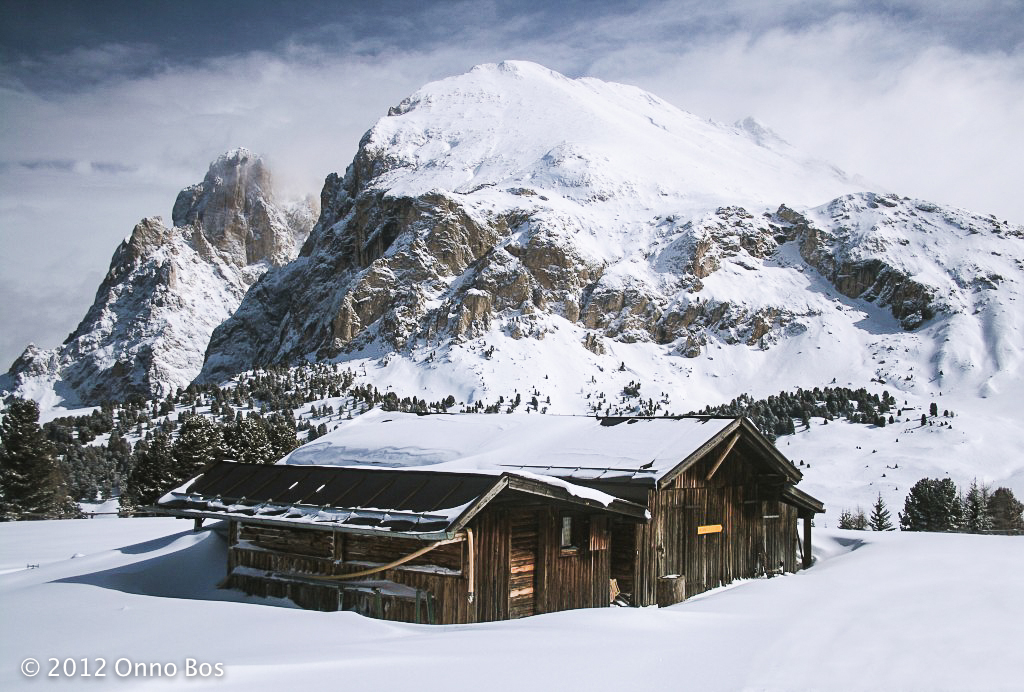
The Charles Inglis Clark Memorial Hut sits at 680 metres in the upper basin of the Allt a' Mhuilinn, almost directly under the great crescent of the Ben Nevis North Face. It is a small stone building, twelve sleeping places, with a coal stove, a long table, and a slate roof that has weathered a hundred Scottish winters.
The hut was built in 1929 by William Inglis Clark and his wife Jane in memory of their son, Charles, killed in the First World War while serving with the Royal Army Medical Corps. It was given to the Scottish Mountaineering Club, which has operated it continuously since.
The CIC, as it is universally known, is a private hut. Bookings are accepted from SMC members and from clubs with reciprocal arrangements. Guests sign a logbook on arrival that runs back, with interruptions, to 1929.
The logbook is the hut's most significant single artefact. It records the named first ascents of Point Five Gully in January 1959, of Zero Gully in February 1957, of Orion Direct in March 1960, and uncountable repeats and attempts in the seven decades since.
The hut sleeps twelve on wooden bunks in two rooms. The kitchen has a coal stove, a propane two-burner, a small sink with cold spring water, and a north-facing window that looks out at the lower buttresses of Carn Dearg.
There is no electricity, no running hot water, and no heating beyond the stove. The toilet is a chemical unit in a small adjacent shed. Snow blocks the door for several days each winter. The hut's caretakers, a rotating team of SMC volunteers, manage routine maintenance.
The walk-in from the North Face car park at Torlundy climbs 600 metres over about five kilometres of rough Highland path. In winter conditions, with packs, most parties take three to four hours. The path crosses the Allt a' Mhuilinn twice and is notoriously boggy in its lower section.
The hut is busiest from January to mid-March, the core Scottish winter season, when conditions on the North Face routes are most reliable. A typical winter weekend has all twelve places booked months in advance.
The North Face above the hut presents one of the most concentrated mixed-climbing arenas in Europe. Within roughly two kilometres of the hut's door lie the Castle Ridge, Carn Dearg Buttress, Number Five Gully, Tower Ridge, Observatory Ridge, Point Five Gully, Zero Gully, and the long Orion Face.
The famous routes are climbed often. Tower Ridge, the easiest of the major lines at Scottish IV, sees perhaps 250 winter ascents in a good season. Point Five and Zero Gully, both at V,5, see roughly 60 to 80 ascents each. The harder modern mixed lines see fewer.
On 14 February 2026, the hut logbook recorded seven parties leaving in pre-dawn for the North Face. Three for Tower Ridge, two for Observatory Ridge, one for Point Five, one for the seldom-climbed Glover's Chimney. All returned safely by dusk.
Conditions on the North Face are notoriously variable. The Scottish Avalanche Information Service issues a daily report for the Nevis Range from December through April. The CIC has a printed copy posted by the door each morning when occupied.
Mountain rescue in the area is provided by the Lochaber Mountain Rescue Team, an entirely volunteer organisation based in Fort William. The team is called to the North Face thirty to fifty times in a typical winter and stages out of the CIC when conditions require.
The hut's coal supply is delivered each autumn by helicopter, ten to twelve hundred-kilogram bags positioned outside the door. The SMC funds the lift from membership dues. Coal use averages about four hundred kilograms across a winter weekend.
Guests are expected to leave the hut as they found it. The unwritten code is enforced quietly by reputation. Parties known to have left a mess are remembered. SMC members who routinely care for the place are quietly thanked.
The current SMC custodian is Iain Macphee, a sixty-three-year-old former joiner from Fort William who has volunteered with the hut for twenty-six years. He visits roughly twice a month in winter to check the building, restock the first-aid kit, and clear snow from the propane vent.
Macphee says the hut has changed less in his time than almost any building he knows. The 1929 stone walls are sound. The slate roof was last fully replaced in 1987 and is good for another generation. The coal stove is the third in the building's history and was installed in 2003.
The CIC is not a romantic place. It is small, dim, smoky when the wind is wrong, and almost always cold. What it offers is something simpler: a stone room four hundred metres from some of the best winter climbing in Britain, kept open through the patience of a club that has not let it close.
The logbook on the long table records, on its most recent page, a party of three Edinburgh climbers in for two nights to attempt the Orion Direct. Their entry, dated 21 March 2026, reads in full: arrived 16:00, conditions excellent, attempt tomorrow, thank you. The next page is blank.