On 8 February 2026 at first light, Cora Quirke and her partner left the Pen-y-Pass car park in Snowdonia under a clear sky and a forecast of moderate easterly wind and no precipitation until evening.
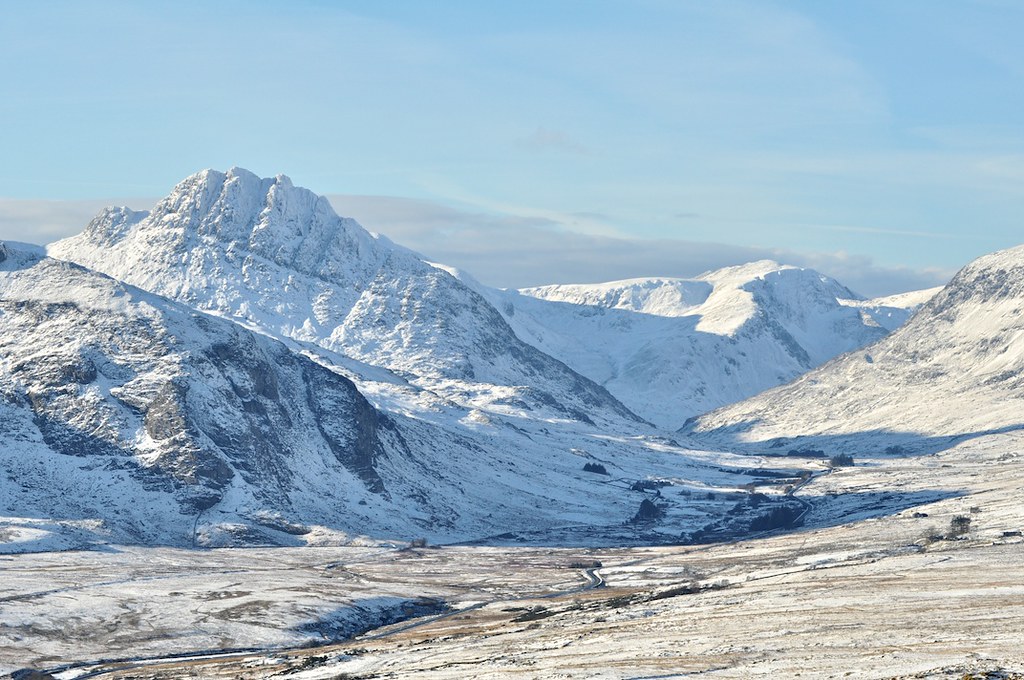
Crib Goch is the eastern arm of the Snowdon horseshoe, a knife-edge ridge of rhyolite that runs for roughly 600 metres at a sustained angle above an exposure of 400 metres on the north side.
In summer the ridge is a graded scramble that a confident hill walker can complete in two hours from the col. In full winter conditions it becomes a serious mountaineering route that has killed walkers nearly every year since the 1960s.
Quirke is a Welsh hill mapper for the Ordnance Survey and has crossed Crib Goch in winter conditions on perhaps forty occasions. She carried, that morning, a 30-metre half rope, a single 60-cm sling, two Dyneema slings, four screwgate carabiners, an ice axe, and crampons.
Her partner carried the same except for the rope and an additional small rack of three nuts and two cams. The total carry weight per person, including water and a flask, was under nine kilograms.
They left the car park at 07:15 and reached the col at the base of Crib Goch's east ridge at 08:40, which is honest pace for the approach in winter boots and breakable crust.
The east ridge in summer is a steep, juggy scramble at British Grade 1. In the conditions Quirke met that morning, with three centimetres of refrozen névé over loose rock, it became a Grade II winter climb.
They stopped at the col and put on crampons, helmets, and harnesses. They tied in to opposite ends of the rope with figure-eights and coiled the spare length over their shoulders in alpine fashion.
On a ridge like Crib Goch, the rope is not used to belay pitches. It is used to short-rope: the leader pays out three or four metres at a time, and the second moves with the rope just taut enough to be felt.
If either climber slips, the other can throw themselves to the opposite side of the ridge and arrest the fall with body weight alone. It is a technique that requires constant attention and that fails completely if either climber is careless.
The east ridge took fifty-five minutes. They reached the summit of Crib Goch, marked by a small cairn at 923 metres, at 09:35. The wind was a steady 30 km/h from the east, with gusts perhaps 50.
The crest of Crib Goch beyond the summit is the section that gives the ridge its reputation. It runs west toward the Crib y Ddysgl pinnacles and the path to Snowdon, and in winter it is sometimes a clean snow arête and sometimes a series of rock pinnacles with verglas.
On 8 February the crest was the second kind. The team moved in short-rope mode for the first 200 metres and then placed a single sling on a rock horn to belay the crux step over the third pinnacle.
The crux took eleven minutes. Quirke led down a small overhanging step, placed the sling, and brought her partner across. They coiled the rope back and continued in short-rope.
They reached the Crib y Ddysgl col at 11:20 and the summit of Snowdon at 12:05. The summit cairn had a brass plaque commemorating the railway's centenary in 2005 and a small frozen rosary that someone had left on the trig.
They descended by the Pyg Track in the afternoon and reached Pen-y-Pass at 14:50. The whole circuit had taken seven hours and thirty-five minutes, which is fast for the conditions but not exceptional.
Quirke has views on what beginners to winter scrambling get wrong on Crib Goch. The first is the rope. Most parties either carry no rope at all or carry one and do not know how to use it efficiently.
The second is the wind. Crib Goch is exposed on both sides and a 40 km/h wind that would be a footnote on the broad summits of the Brecons becomes a serious balance problem on a 30-cm-wide arête of refrozen snow.
The third is the descent. The Pyg Track in winter is often a long ice slope where the path crosses the upper coombe, and parties who have committed all their attention to the ridge sometimes underestimate the descent.
Quirke does not recommend Crib Goch in winter to anyone whose previous winter experience is limited to walking the Cairngorm plateau. The ridge requires a moving belay technique that can only be learned with practice on easier ground.
She suggests, for parties working toward it, the Striding Edge of Helvellyn first, then the Aonach Eagach in early winter when there is just enough snow to require crampons but not enough to require pitched belaying.
There is no romance in this advice and Quirke knows it. The romance of Crib Goch in winter is for people who have done it. The work of arriving there competently is what the magazine talks about.