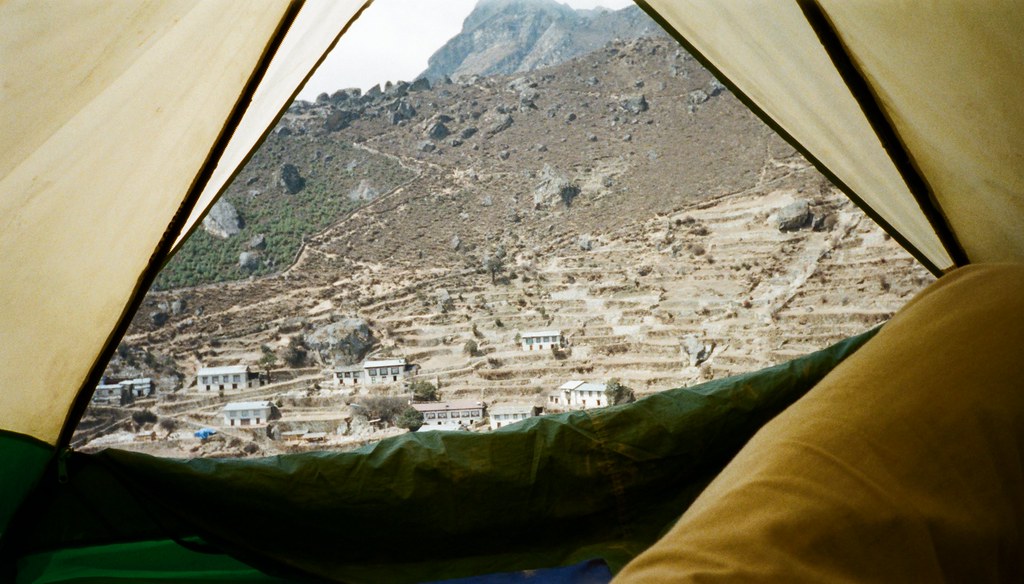
The Sherpa Mountaineering Cooperative's main office is a two-room building at the southern end of Namche Bazaar, behind a bakery that sells almond cake, and it is the only building in town with a brass plaque next to the door.
The plaque is small, perhaps fifteen centimetres on a side, and reads, in Nepali, English, and Tibetan: "Sherpa Mountaineering Cooperative, founded 2014, Namche Bazaar, Solukhumbu." There is no logo and no slogan. The brass is dull. Nobody polishes it.
The cooperative was founded in October 2014, six months after the Khumbu Icefall avalanche that killed sixteen Nepali high-altitude workers, by a group of seventeen Sherpa guides who had decided, with what one of them later described as a particular kind of slow anger, that the structure of Everest commerce required revision.
Its founding chair was Lhakpa Dorje, then forty-three, a six-time summit veteran from the village of Khumjung. He died of a heart attack in 2021 at the age of fifty, and the cooperative's main meeting room is named for him. His photograph hangs above the desk where his successor, a woman named Pemba Yangzi, now works.
Yangzi is the cooperative's second chair and its first woman in the role. She is fifty-one, was born in Phortse, and worked as a kitchen manager at Everest base camp for nine seasons before she became a logistics manager and, eventually, the cooperative's full-time administrator. She has never summited Everest and has no intention of doing so.
The cooperative's model is simple in description and complicated in practice. Member guides pool a portion of their season's earnings into a shared fund. The fund pays for life insurance at higher levels than the government minimum, for medical evacuation that is not contingent on a client's policy, for the education of children whose fathers have died in the mountains, and for the seasonal hiring of younger Sherpas at wages set by the cooperative rather than by individual expedition operators.
The member wage in spring 2026 was set at 11,200 US dollars for a full Everest season, plus a summit bonus of 1,800 dollars. By the cooperative's own accounting, this is roughly thirty per cent higher than the rate paid by the lowest-cost foreign operators and approximately equal to the rate paid by the highest-cost ones.
Membership in 2026 stands at one hundred and forty-three Sherpa guides, drawn from villages across the Khumbu and the Solu, with a small representation from the Rolwaling Valley to the west. Membership is by invitation and requires the sponsorship of two existing members. The cooperative has, since its founding, declined four times as many applicants as it has accepted.
The decline is rarely about competence. It is, Yangzi says, about whether the candidate can be relied on to honour the cooperative's most distinctive rule, which is that members do not undercut the cooperative wage on private expeditions and do not, in the high season, take work from operators who have been publicly identified as paying below it.
The list of such operators is maintained, quietly, by the cooperative's three-person ethics committee. It is not published. It is shared among members each February. It has, over twelve seasons, contained between four and nine names. Some of the names have appeared on it for ten consecutive years.
The cooperative does not operate expeditions itself. It is, in legal terms, a labour cooperative rather than a trekking agency. Members are hired individually by foreign and Nepali operators, but the rates at which they are hired, and the conditions of their employment, are negotiated by the cooperative on their behalf.
This arrangement has produced, over time, two effects that were not entirely intended. The first is that membership has become, for younger Sherpas considering a career in high-altitude work, a credential of nearly the same weight as the Nepal Mountaineering Association's guide certification. The second is that the cooperative has come, by quiet attrition, to act as a kind of informal regulator of the Khumbu's guiding economy.
The regulation is not enforceable in any legal sense. The cooperative cannot fine an operator or revoke a permit. What it can do, and has done, is to decline, collectively, to staff that operator's expeditions. In a labour market as thin as the Khumbu's high season, this has the same effect as a fine.
The cooperative's annual general meeting was held this year on 14 April 2026 in the upper room of the Liquid Bar, a tea-house and music venue on the south side of Namche, because the cooperative's own meeting room cannot seat one hundred and forty-three people. The meeting lasted six hours and was conducted in three languages.
The single item of substantive business was a proposal, brought by a younger member from Khumjung named Ang Sona, to raise the death benefit paid to a member's family from the current eighty thousand dollars to one hundred thousand. The proposal passed, after some debate, by a show of hands. The debate was not about the amount but about the source of the additional funds.
The decision was made, in the end, to increase the cooperative's seasonal fund contribution by two hundred dollars per member, drawn from the summit bonus rather than the base wage. Several older members noted, dryly, that this would reduce the amount they themselves would receive on their own next summit, and voted for the proposal anyway.
The cooperative's life insurance arrangements are administered through a Kathmandu broker who has, by Yangzi's careful accounting, paid out on twenty-three death claims in twelve years. The deaths have been spread across the seasons but have concentrated, as expected, in the spring Everest window and in two specific avalanche events on Manaslu and Annapurna.
The bereaved families are visited, in the autumn following each death, by a cooperative member from the same village. The visits are not photographed and are not publicised. They include, as a matter of policy, the delivery of a written account of the deceased's last days on the mountain, prepared from the recollections of the colleagues who were with him.
The cooperative's archive in Namche contains, as of this spring, twenty-three such accounts. They are kept in a wooden cabinet behind Yangzi's desk. The cabinet is not locked. It is, however, opened only by members of the deceased's family and by a small number of researchers, of whom this writer, after several conversations, was eventually one.
The accounts are written in the language the deceased preferred. Most are in Nepali. Several are in Sherpa. Two are in English, written by foreign clients who survived the same incident and who insisted, against the cooperative's preference, on contributing.
What the cooperative has done, twelve years on, is not to have ended the dangers of high-altitude work in the Khumbu. The dangers are intrinsic to the work. It has done something more limited and, in its founders' view, more durable. It has organised the wages, the insurance, and the bereavement of the Sherpa guiding profession into a structure that does not depend on the goodwill of any individual operator.
This is a smaller achievement than the founders, in 2014, hoped for. It is a larger achievement than most observers, in 2014, expected. Yangzi, asked what she thinks the cooperative will look like in ten years, said only that she hopes the brass plaque will still need no polishing.
Filed under