Caleb Yost lives in a small cabin on the eastern slope of the Sierra Nevada, ten kilometres north of Mammoth Lakes, at an elevation of 2,470 metres. He works in winter as an independent snow observer, paid on a per-profile basis by two heli-skiing operators, the Eastern Sierra Avalanche Center, and occasionally by a Nevada utility company that operates a watershed upstream of his cabin.
He has been doing this since the winter of 2012-13, when he took the AIARE Level 2 course in Tahoe and decided, rather than apply for a forecaster's position with the Forest Service, to work for himself. He is now 47.
His tools are a Snowmetrics aluminium probe, a Brooks-Range crystal card, an Ortovox magnifier, a thermometer that he calibrates each November in an ice bath at the cabin sink, a saw, a shovel, and a Rite in the Rain field notebook of the type used by foresters and surveyors. He has filled forty-two such notebooks since 2012.
The notebooks live, in chronological order, on a shelf above his stove. The oldest is dated 14 December 2012. The most recent, when this article was written, was dated 8 April 2026 and was still in use.
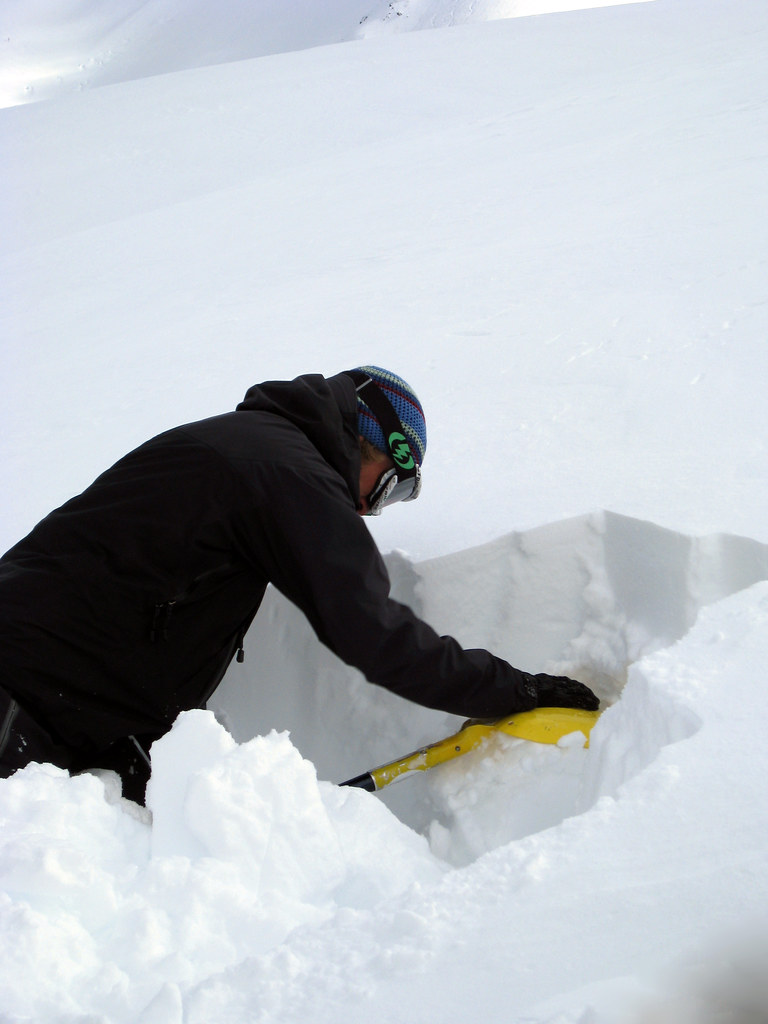
A snow profile, as Yost performs it, takes between forty minutes and two hours. He digs a pit to the ground, or to a depth of 250 centimetres, whichever comes first. He measures the temperature gradient through the pack at ten-centimetre intervals. He identifies each layer by grain type, hardness, and crystal size. He performs at least one stability test, usually a Compression Test and an Extended Column Test, and records the results using the standard notation.
He also draws each profile by hand, in pencil, on the grid pages of the notebook. The drawings are clean, careful, and small. They include weather observations, slope angle and aspect, the date and time, and any comment Yost wishes to record.
The comments are where the notebooks become interesting.
An entry from 22 January 2016 reads, in the comment field: 'Found a glove buried at 80 cm. Right-handed, blue, well-used. No idea whose.' An entry from 3 March 2018 reads: 'ECT propagating on the November interface for the fourth time this winter. This layer is going to kill someone before April.' An entry from 28 April 2022 reads: 'Bird overhead, possibly Clark's nutcracker. Pit dry, isothermal at 195 cm. Snow over.'
The Sierra Nevada snowpack is, by reputation, more cooperative than the continental snowpack of the Rockies. Storms tend to be wet and warm. Layers tend to bond. Persistent weak layers form less reliably and heal more reliably. The phrase 'Sierra cement' is sometimes used, not always kindly, to describe the dense, well-settled snow that the range produces.
But the Sierra also produces, in some years, a layer of buried surface hoar or near-surface facets that behaves very much like a Rockies snowpack and kills people in the same way. Yost's notebooks document, across fourteen winters, twenty-three such layers. He has watched some of them develop, persist, and eventually fail.
The winter of 2016-17, an extreme wet year that broke the California drought, produced almost no persistent layers and very few notebook entries with the word 'concern' in them. The winter of 2020-21, by contrast, produced a layer of December surface hoar that was still propagating in compression tests in late March, and Yost wrote a heli-skiing operator twice during that period to recommend that specific terrain be closed.
The operator closed it. Yost's notebooks suggest he was right to.
The 2025-26 Sierra winter was a near-average season in terms of total snowfall, with the Mammoth Pass snow pillow reading 11.4 metres of cumulative snow by 1 April, against a thirty-year average of 11.1. But the snow arrived unevenly, with a dry November, a wet December and January, a remarkably dry February, and a March that produced four storms of one metre or more.
Yost's notebook for the season contains forty-one full profiles, two preliminary digs that he abandoned because the wind made writing impossible, and a long entry from 14 February that has nothing to do with snow.
The entry concerns a coyote that crossed Yost's ski tracks twice in the same morning, in opposite directions, with what he describes as 'no apparent hurry.' He drew the tracks in his notebook in some detail. He noted the time and the temperature. He concluded, characteristically, with a single sentence: 'I do not know what the coyote was doing.'
He has been asked, by clients and by the avalanche centre, why he still uses paper notebooks when most professional observers have moved to tablet-based applications. His answer, when he gives one, is that the act of drawing the profile by hand forces him to look at the snowpack more carefully than typing it into a form would. He does not say it improves accuracy. He says it improves attention.
He has, in fact, made errors. A notebook entry from 11 March 2019 contains a layer hardness rating that he later annotated, in a different pencil, with the word 'wrong.' The corrected value is written above. He does not erase his mistakes.
The notebooks have begun, in recent years, to attract attention beyond Yost's small client list. A graduate student at the Desert Research Institute in Reno asked, in 2024, whether the archive might be digitised for use in a long-term study of Sierra snowpack trends. Yost agreed in principle but has not yet sent the notebooks.
He says he wants to finish the current one first.
On 8 April 2026 he dug a pit on a north-east aspect at 3,150 metres above Convict Lake. He found 198 centimetres of snow, isothermal in the upper two-thirds, with the December surface-hoar layer still discrete at 142 centimetres but no longer propagating in any of his tests. He wrote in the comment field: 'Layer dormant. Spring conditions established. Last profile of the winter, probably.'
He took the notebook home, put it on the shelf above the stove, and started thinking about which spring objectives, on which aspects, would be worth a long walk in May.