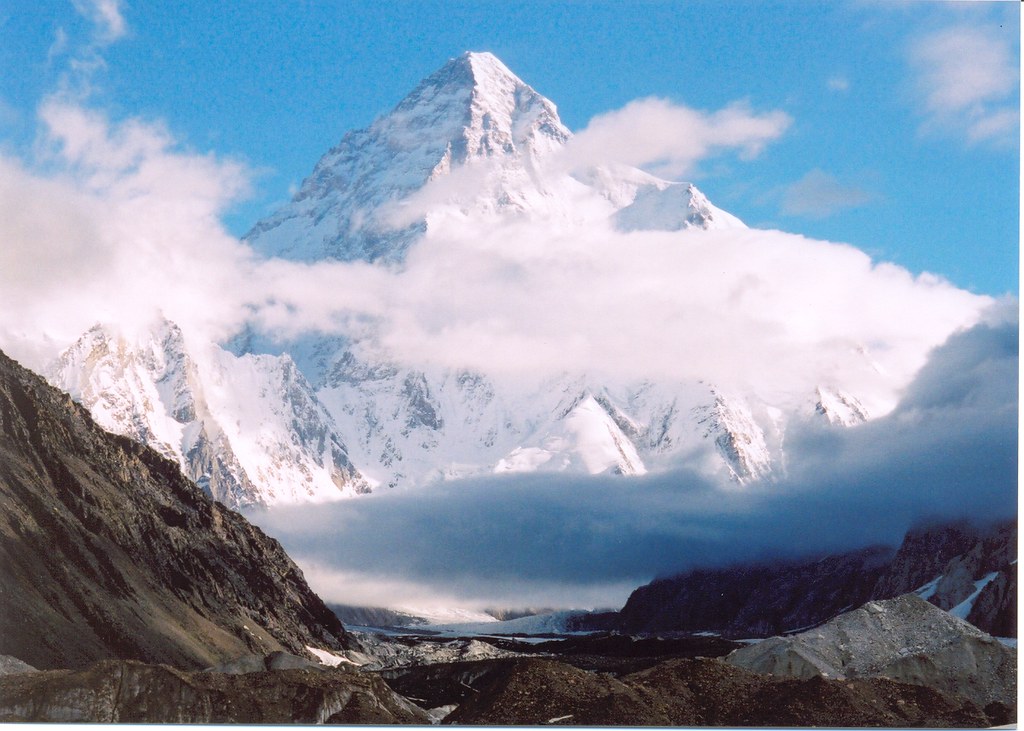
On the evening of 30 July 1954, at roughly 8,100 metres on the Abruzzi Spur of K2, a twenty-four-year-old climber named Walter Bonatti spent the night in the open with the Hunza porter Amir Mahdi. They had no tent. They had no sleeping bags. They had two oxygen cylinders intended for the summit pair, Achille Compagnoni and Lino Lacedelli, who were camped, Bonatti believed, somewhere above them at Camp IX.
Bonatti and Mahdi survived. Mahdi lost most of his toes and parts of his feet. The summit pair reached the top of K2 the next afternoon and were celebrated, on their return to Italy, as the first men to climb the second-highest mountain on earth. The Italian Alpine Club's official account, written by the expedition leader Ardito Desio, gave the credit to Compagnoni and Lacedelli. Bonatti's name appeared in the supporting role.
The dispute that followed lasted fifty-three years. It became, in Italian climbing culture, what the Mallory question is in British: a piece of unsettled history that every generation has to look at again. The argument was not about whether K2 had been climbed. It was about where Camp IX had been pitched, why Bonatti had been left below it overnight, and whether the summit pair's account of the bivouac was honest.
Compagnoni and Lacedelli's account, as recorded in Desio's 1955 book La conquista del K2, said that Camp IX had been pitched at the planned location, that Bonatti had failed to reach it with the oxygen by nightfall, and that the summit pair had used the oxygen for the final push the next morning, running out roughly forty metres below the summit and climbing the last section without it.
Bonatti's account, in his 1961 book Le mie montagne, agreed on the broad sequence but disagreed on two points. He said Camp IX had been pitched higher than agreed, leaving him unable to reach it before dark, and that he and Mahdi had carried the oxygen up to within shouting distance of the camp, which the summit pair had then collected in the morning. He said the oxygen had not, in fact, run out below the summit, and that the published account had been altered to hide the fact that the climbers had used Bonatti's load.
The dispute escalated slowly. In 1964, an article in the magazine Nuova Gazzetta del Popolo alleged that Bonatti had drunk the summit pair's oxygen during the bivouac, in an attempt to steal the summit for himself. Bonatti sued for libel and won. The court found the allegation false. The article's source was Compagnoni.
From that moment, Bonatti's case had a documentary basis. The court had found, in 1966, that Compagnoni had lied about a specific point. The question was whether the lie had been protective, covering an embarrassment, or had been part of a larger pattern.
Lacedelli, for the first thirty years after the climb, declined to comment on the dispute beyond what Desio's book had said. He was a careful man, a Cortina mountain guide of long standing, and not given to public quarrels. He retired from guiding in 1986 and lived quietly in Cortina d'Ampezzo until his death in 2009.
In 2004, on the fiftieth anniversary of the climb, Lacedelli broke his silence. In a short book co-written with the journalist Giovanni Cenacchi, K2: Il prezzo della conquista, he confirmed three things. Camp IX had been pitched higher than agreed. Bonatti had carried the oxygen as he had always said. The summit pair had used Bonatti's oxygen for the final push.
Lacedelli's confirmation, fifty years late, effectively closed the dispute. The Italian Alpine Club commissioned a formal review, chaired by the alpinist Luigi Zanzi, which reported in 2008. The CAI's review accepted Bonatti's account on every disputed point and issued a formal correction to the 1954 expedition history.
The correction was not retroactive in any meaningful sense. Compagnoni had died in 2009. Lacedelli died the same year. Desio had died in 2001. The men whose reputations the correction altered were beyond its reach. The man whose reputation the correction restored, Bonatti, had died in 2011 at the age of eighty-one, three years after the CAI's report.
What the long argument left, beyond the corrected history, was Bonatti's climbing record itself, which the dispute had distracted attention from for half a century. Between 1955 and 1965, working as a guide out of Courmayeur, Bonatti made some of the hardest solo climbs in alpine history. The Bonatti Pillar on the Petit Dru in 1955, climbed in five days alone, is one. The north face of the Matterhorn in winter, climbed solo in February 1965, is another.
Bonatti retired from serious climbing at thirty-five. He spent the next forty years as a travel correspondent for Epoca magazine, walking in the Amazon, in Patagonia, in the deserts of southern Africa. He climbed for himself. He published a series of long photographic books that sold well in Italy and not at all in English.
The 1954 expedition is now taught at the IFMGA aspirant course in Courmayeur as a case study in expedition decision-making. The class is led by a senior Italian guide, currently Marco Furlani, and runs for an afternoon. The students read both accounts and the 2008 CAI report. They are asked to consider what they would have done at each decision point.
Furlani told the writer in May 2026 that the students always reach the same conclusion. The decision to pitch Camp IX above the agreed location was understandable, given the snow conditions of that afternoon. The decision not to come down to help Bonatti and Mahdi, knowing they were bivouacking in the open, was not.
The 1954 ascent is also taught at the Pakistan Air Force's high-altitude course at Skardu. The Pakistani interest in the climb is partly a matter of national history — K2 is Pakistani territory — and partly a matter of the role of Amir Mahdi, the Hunza porter who lost his feet on the bivouac. Mahdi was paid four hundred rupees, the equivalent of about three months' wages, and was not invited to the celebration tour.
Mahdi died in 1999 in his home village of Sost, north of Hunza. The Pakistani government granted him a small pension in his last years. The Italian Alpine Club's 2008 report formally acknowledged his role and named him, alongside Bonatti, as having carried the oxygen on which the summit depended.
K2 itself, in 2026, is climbed by roughly two hundred people a year, almost all of them on the Abruzzi Spur. The route is fixed-roped from Camp I to the summit. Most clients use oxygen. The Bottleneck, the steep snow couloir below the summit, has become more dangerous as the serac above it has retreated. Eleven climbers died there in a single day in August 2008.
The mountain is no easier than it was in 1954. The climbing is more travelled, the gear is better, the weather forecasting is better. The summit-day choices — when to go, when to turn around, who to wait for, who to leave — are the same ones that Compagnoni and Lacedelli made on the morning of 31 July 1954.
Bonatti, in a 2009 interview with the present writer's father, said the lesson of K2 was simple. The mountain, he said, will tell you everything you need to know about the people you have come with. You only need to be willing to listen to what it says, and to remember it afterwards.