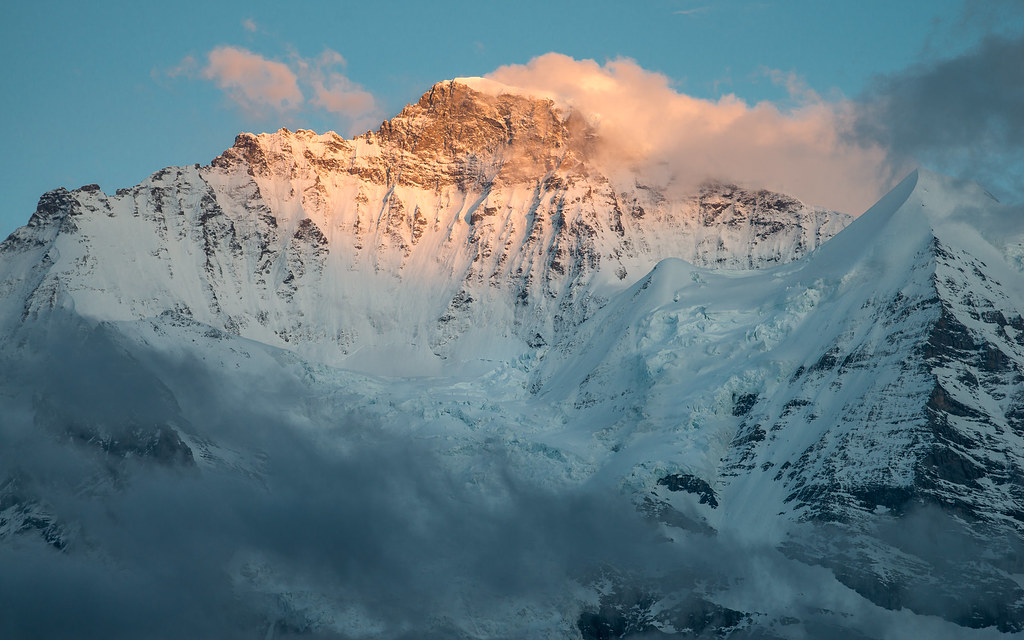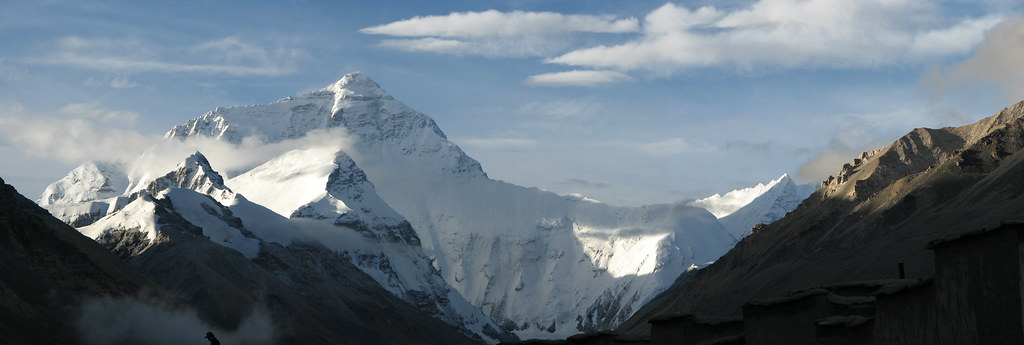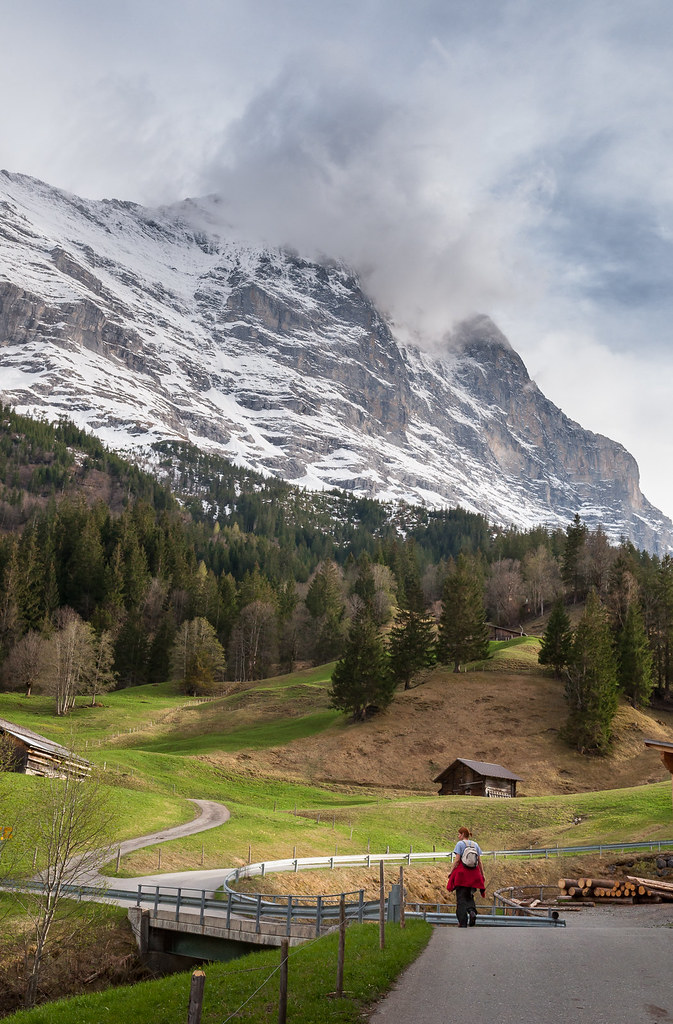
The north face of the Eiger rises 1,800 metres above the Kleine Scheidegg railway station, a wall of grey limestone and ice that has been visible from a public bench for the entire history of attempts to climb it. It was first climbed in July 1938 by an Austrian-German party of four — Heinrich Harrer, Fritz Kasparek, Anderl Heckmair, and Ludwig Vörg. By that date the wall had already killed eight climbers.
Two of those eight were Andreas Hinterstoisser and Toni Kurz, who died in July 1936 during the attempt that gave the route its first piece of named geography, the Hinterstoisser Traverse. The other two members of their party, Willy Angerer and Edi Rainer, died in the same retreat. The 1936 recovery — or rather the failure of a recovery — is the most well-documented mountain death in alpine history and has been written about by almost every climber who has subsequently attempted the wall.
The 1936 party had climbed to roughly 3,300 metres on the wall in three days, reaching a ledge known as the Death Bivouac. Angerer was injured by rockfall on the second day. By the morning of the fourth day, in worsening weather, the party decided to retreat. Hinterstoisser, who had led the diagonal traverse that bore his name on the way up, could not reverse it on the way down. The fixed rope had been pulled.
The party descended directly downward instead, into the lower icefields, in a storm. Hinterstoisser fell to his death. Angerer was strangled by his own rope when Kurz fell. Rainer died of cold and exhaustion on the rope below Kurz. Kurz himself was left hanging from the rope, alive, two hundred metres above the railway tunnel window from which the Jungfraubahn rescue party had emerged.
The rescue attempt that followed is the famous one. Three Swiss guides — Hans Schlunegger, Adolf Rubi, and Christian Rubi — climbed from the tunnel window through deteriorating weather to within twelve metres of Kurz. They could not reach him directly. They tied two ropes together and lowered them to him.
Kurz, with one hand frostbitten and useless, the other only partly working, took six hours to unpick his ropes, attach the new ones, and begin to be lowered. The knot joining the two rescue ropes jammed in his carabiner. He could not get it through. He said, in his last clear words to the guides below, Ich kann nicht mehr. I can do no more. He died on the rope, twelve metres above the rescue party, on the afternoon of 22 July 1936.
The body could not be recovered. It hung on the wall for the rest of the summer of 1936 and through the autumn, visible from the Kleine Scheidegg with binoculars. The Jungfraubahn rescue service finally cut it down with a long-handled hook in October. Kurz is buried in the cemetery at Grindelwald. Hinterstoisser, Angerer, and Rainer are buried at the same site, in a single plot. The headstone, in three lines, gives their names and the date.
The 1957 recovery is less famous and in some ways harder to read. In August 1957, an Italian party of four — Stefano Longhi, Claudio Corti, Günther Nothdurft, and Franz Mayer — attempted the face. Nothdurft and Mayer were German and had joined Corti and Longhi on the wall. They were one of two parties on the route that week.
The climb deteriorated. By the third day Longhi was injured and could not move. Corti remained with him on a ledge below the White Spider. Nothdurft and Mayer continued up, intending to summit and descend by the easier west flank to alert a rescue.
Nothdurft and Mayer reached the summit. They were last seen by a party on the west flank on 8 August. They did not arrive in Grindelwald. Longhi, on his ledge below the White Spider, died of exposure on the morning of 9 August. Corti, alone above him, was rescued from the summit ridge by a guide party who climbed the easier west flank and used a cable winch to lift him over the cornice.
The Corti rescue, which used roughly four hundred metres of steel cable and twelve men working in two-hour shifts through a night in storm, was the largest mountain rescue ever attempted on the Eiger to that date. It succeeded. Corti survived. He spent the rest of his life maintaining that Nothdurft and Mayer had reached the summit with him, and had then descended the west flank ahead of the rescue and disappeared.
His account was disbelieved at the time. The Swiss alpine community broadly assumed that Corti had abandoned his companions, including the two Germans, and had lied to cover the fact. Corti was not invited back to the Eiger for fifteen years.
In 1961, four years after the Longhi recovery, two German climbers came across the bodies of Nothdurft and Mayer on the west flank of the Eiger, roughly four hundred metres below the summit, in a small couloir at 3,500 metres. They had died of exposure, descending in storm, after reaching the summit. Corti's account had been correct.
The vindication came late and was incomplete. Corti was readmitted to the Italian Alpine Club. He attempted no more major climbs. He died in 2010 in his home village of Olginate, at the age of eighty-two. His Eiger ice axe is in the Italian Alpine Museum in Turin, in a display case alongside the Bonatti axe from K2.
The Longhi body, which had hung on the ledge below the White Spider for two years, was recovered in 1959 by a Swiss-German party led by Lothar Brandler. The recovery party climbed the wall with the explicit objective of retrieving the body, which had become a tourist attraction at the Kleine Scheidegg telescope. Brandler's party brought the body down to the railway tunnel window and from there by train to Grindelwald.
Longhi is buried in the cemetery at Grindelwald, in a plot adjacent to the 1936 Austrians. Nothdurft and Mayer are buried in the same cemetery, in a plot recovered when the bodies were brought down from the west flank. The four 1936 climbers and the three 1957 climbers — Longhi, Nothdurft, and Mayer — share a corner of the cemetery. The graves are kept by the Grindelwald commune and visited regularly by climbers who have completed the route.
The Eiger north face has now been climbed thousands of times. The current speed record, set by the Swiss climber Dani Arnold in 2015, is two hours twenty-two minutes. Arnold soloed the route in good winter conditions. He has said, in interviews, that he thinks about the 1936 party when he passes the Hinterstoisser Traverse, and that he leaves a small piece of climbing gear at the Death Bivouac each time he passes it. He has done so on every solo ascent.
The Hinterstoisser Traverse itself, which the 1936 party could not reverse, has been fixed with a permanent steel cable since the late 1990s. The cable was placed by the Swiss Alpine Club after a series of incidents involving parties unable to reverse the section. The cable can be clipped on the way up and used as a handrail on the way down. It would have saved the 1936 party.
The 1957 recovery, which proved Corti right about Nothdurft and Mayer, is less commemorated than the 1936 attempt and less famous than the 1938 first ascent. It sits between them in the cemetery and in the history. It is, in some ways, the more honest of the two stories. The mountain did not test the climbers' loyalty to each other. The climbers tested their own.
Filed under